
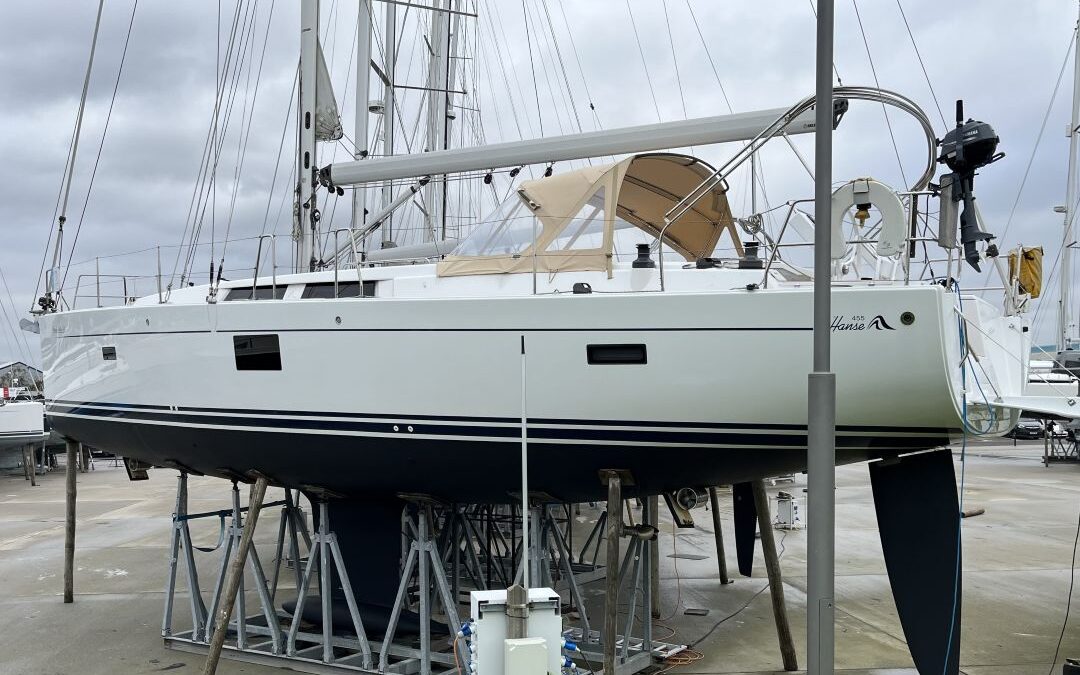
During the late 2000’s Hanse geared up their production facilities and streamlined their production techniques. Its interesting to compare the build quality of the older models to the newer models.
I previously owned a Hanse 411, and it was clear where the manufacturer had cleverly and successfully reduced the costs to build.
This 2015 Hanse 455, built in Germany, is one model of a very popular range built over the last decade or two.
Keel
The older vessels (pre circa 2005/6) had composite keels with the upper section of cast iron and the lower section of cast lead. The more recent Hanse models now have a cast iron keel with a bulb to reduce the centre of gravity.
Structural strength & rigidity
The newer models make more extensive use of an inner tray / matrix / grid / liner for structural strength and rigidity. This is quick to build off vessel and is then bonded in with structural epoxy paste to provide longitudinal and transverse rigidity, as well as tying together rig, mast and keel loads.
Windage
The more modern Hanse designs have high topsides. These provide plenty of space and additional headroom but means there is more windage. This is noticeable when manoeuvring to berth. Most models of this size are equipped with a retractable bow thruster, and many also have a retractable stern thruster, to assist with manoeuvring.
Seacocks
When buying a boat, it’s a good idea to look at the condition of the seacocks.
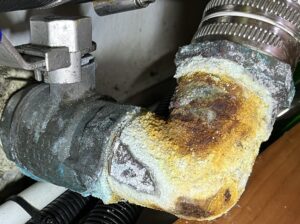
Corroded seacock tail elbow.
For many modern vessels the original seacocks are often CW617N (brass), which do not have good longevity. They are cheap to buy and satisfy the EU’s RCD, so most manufacturers fit these cheap metals for the underwater fittings.
The seacock valve, together with the other components of the seacock: the skin fitting, the internal nut and the hose tailpipe (straight or elbow), can often be either corroded or dezincified. A seacock valve which is pink in appearance, means the zinc has leached leaving a copper rich brittle alloy remaining. This reduces strength and is a risk.
If in any doubt about the integrity of any component of the seacock assembly then the whole assembly should be replaced. This usually means grinding off the skin fitting and pushing through internally, then replacing all components. On this Hanse 455, one of the seacock tail elbows was corroded and would need replacing.
Retractable thrusters
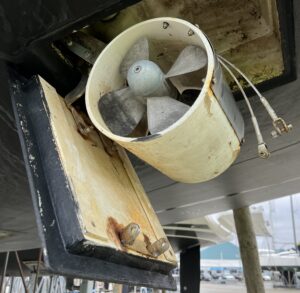
Thruster fairing piece in need of a new bracket.
The retractable bow and stern thrusters are efficient when in use, while also being streamlined when sailing. The stainless-steel hinges can fail. On this example, the stern thruster was awaiting a component on the hinge/bracket on the GRP fairing piece to replace the original failed component.
Of course, as with any vessel, ongoing maintenance and a replacement cycle for components is required. A survey is only an “as at” a moment in time condition check and cannot guarantee future maintenance costs or schedules.
Please do contact us to discuss your survey requirements.